Best World Anvil Alternatives for Campaign Planning
World Anvil is a great wiki, but it isn't the only option for D&D worldbuilding. Compare the best free and paid World Anvil alternatives — Lorekeeper, MythScribe, Obsidian, and Notion — for DMs who want to actually run sessions, not publish a setting.

Why DMs Look for World Anvil Alternatives
World Anvil is the most well-known worldbuilding platform in the TTRPG space, and for good reason — it has interactive region maps, a polished public-facing wiki, and a community that'll help you build a setting deep enough to publish.
But most DMs aren't publishing a setting. They're trying to run a session next Tuesday. The complaints we hear most often are the same: the free tier is too cramped to actually use, the article templates feel like blank pages waiting for homework, BBCode formatting eats time that could've gone into prep, and half the paid features are for presentation rather than play.
If that sounds familiar, you don't need a better wiki — you need a different shape of tool entirely. Below are the four World Anvil alternatives we recommend most often, what each one is actually good at, and which kind of DM should pick which.
What World Anvil Does Well (Set the Bar)
Before we get into alternatives, it's worth being honest about what you'd be giving up. World Anvil is genuinely the best in class for:
- Public-facing player wikis. If your players read between sessions, World Anvil's reader-mode polish is hard to beat.
- Interactive region and world maps. Pin locations, link to articles, layer political borders — nobody else does this as well at the price.
- Long-form lore presentation. Timeline displays, BBCode-styled articles, and customizable themes turn a setting into something that reads like a novel companion.
- VTT integration. Roll20 and Foundry plugins for sharing content directly to play sessions.
If those are the things you actually use World Anvil for, stay there. If you're paying for them and never touching them, the alternatives below will feel like a relief.
Free Wondrous Hooks PDF + 10% off your first order
12 ready-to-run quest hooks (Fantasy & Fable Vol. 1), plus SUBSCRIBER10 and new tools — a couple of times a month, never spam.
The Best World Anvil Alternatives
1. Lorekeeper — The Notion Template Built for D&D 5e
Best for: DMs who want a connected linked database without building it themselves, and who prefer a polished UI to a raw editor.
Notion has been a popular World Anvil alternative for years because of its linked databases — NPCs, factions, quests, and locations can all reference each other and roll up into dashboards. The catch is that building the schema yourself is a weekend project most DMs never finish.
Lorekeeper skips that setup entirely. It's a 5e-focused Notion template with linked databases for NPCs, locations, factions, items, lore, and quests, plus a session tracker, a combat log, and a player handout system. You duplicate it into your workspace, add your campaign, and you're running.

Where it beats World Anvil: zero setup time, no BBCode, free tier of Notion is generous enough to run a full campaign, and it works on every device you already own. Where it doesn't: there's no public-facing wiki and no interactive region maps. If you want to share your world with players, you'd share the Notion page or export to PDF.
Pricing: One-time purchase of the template. Notion itself is free for personal use, which covers everything a single DM needs.
2. MythScribe — Purpose-Built Campaign Tool with Typed Entities
Best for: DMs who want stat blocks, encounter balance, and generators in the same place as the wiki.
MythScribe takes a different approach to the World Anvil problem. Instead of a wiki you fill in, it gives you eight typed entity types — NPCs, locations, factions, quests, items, lore, events, and encounters — each with the fields they actually need. NPCs have ability scores and skills. Encounters have CR-balanced generation tied to party level. Quests have a quest-giver dropdown that pulls from your real NPC list.
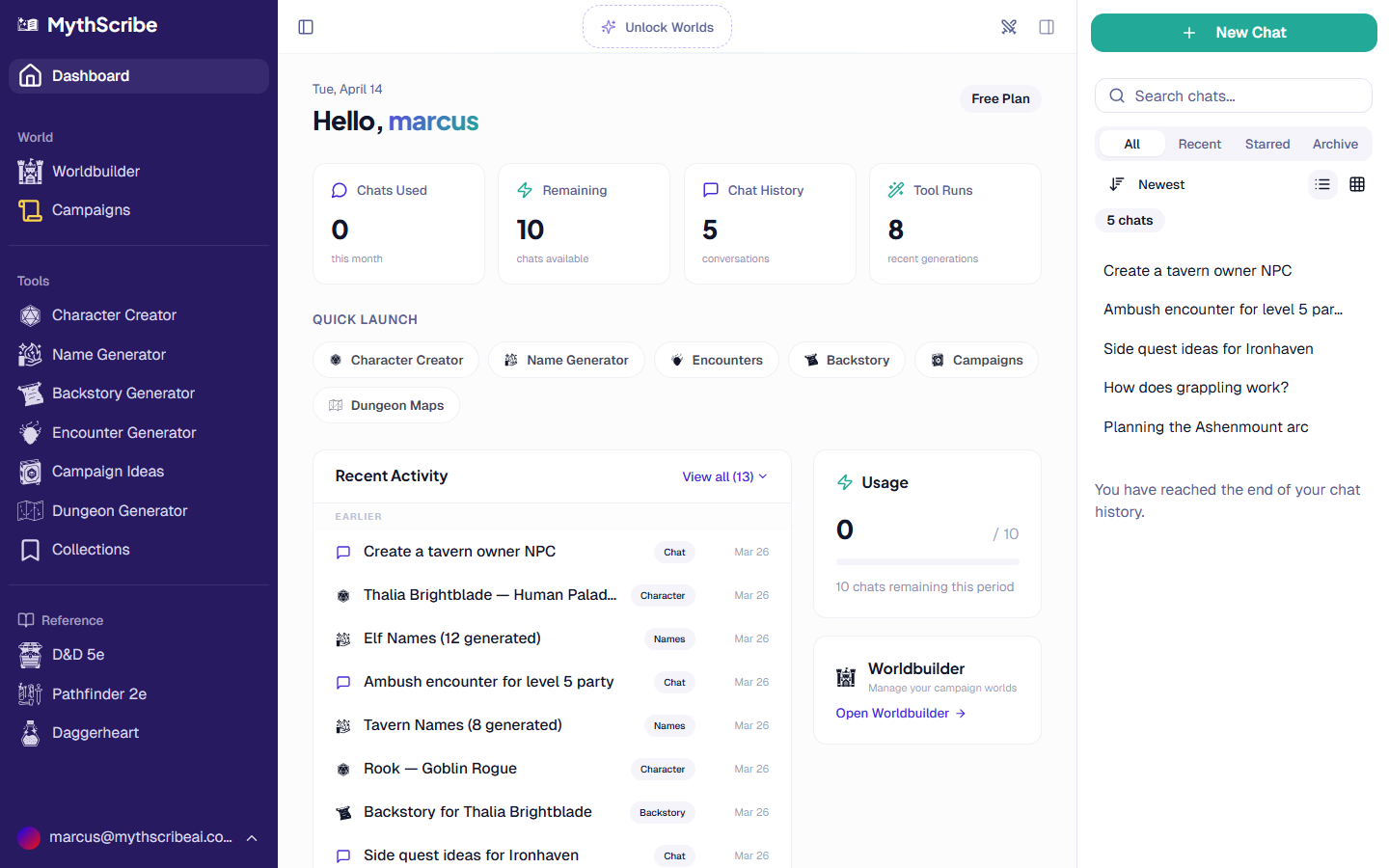
The thing that makes it feel different from World Anvil: the blank-page problem is solved before you start. There's a backstory generator with personality, ideal, bond, and flaw. A name generator that's lore-aware per system. A procedural dungeon map generator with rooms and corridors. An AI assistant that knows your world's NPCs, factions, and lore — ask for "a smuggler NPC in Ironhaven with ties to the Crimson Hand" and you get one that actually references entities that exist in your campaign.
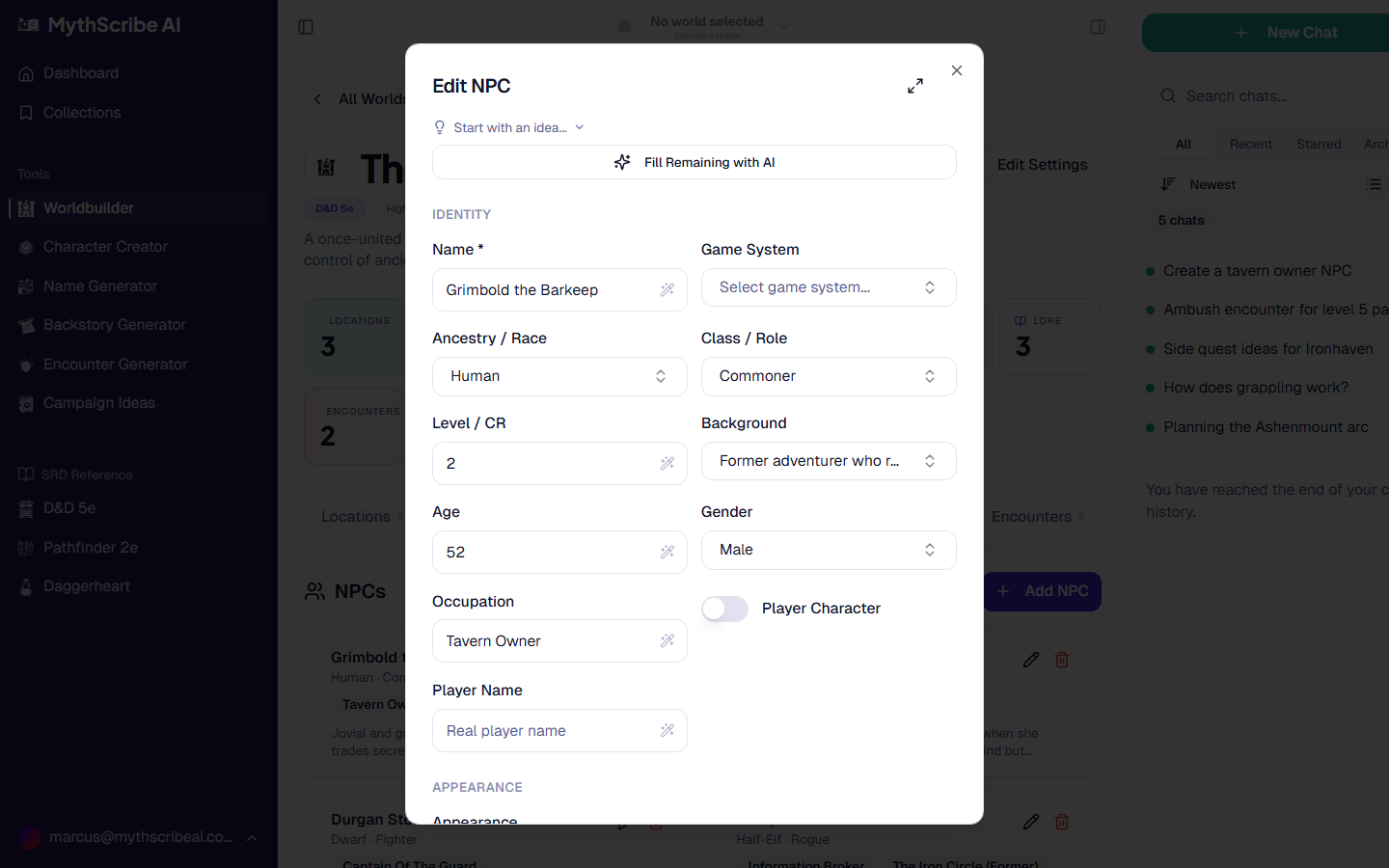
It supports D&D 5e, Pathfinder 2e, and Daggerheart natively, so if your group switches systems or runs multiple campaigns, everything works in one account. There's a 7-day free trial and pricing starts at $5/month — slightly cheaper than World Anvil's entry tier, with the dungeon generator, encounter builder, character creator, and worldbuilder all on one plan.
Where it beats World Anvil: typed fields instead of free-form articles, built-in generators that fill the wiki for you, AI assistant that knows your world, and CR-balanced encounter design. Where it doesn't: no public-facing player wiki, no interactive region maps (only dungeon maps), and no VTT integration. If you want a side-by-side feature breakdown, MythScribe maintains a detailed comparison page that goes deeper than this section.
Pricing: Free trial for 7 days, paid plans from $5/month.
3. Obsidian — Free, Local-First, Markdown-Powered
Best for: DMs who already use markdown, want full control, and want their notes to live as plain text files on their own machine.
Obsidian is the most popular free World Anvil alternative for a specific kind of DM — the one who wants their worldbuilding to outlive any company's subscription. Every note is a plain markdown file in a folder you own. Internal links are real links: type [[Ironhaven]] and you've created a reference to the Ironhaven note. The graph view turns those links into a visual map of how your world connects.
Plugins extend it from there. Dataview turns folders into queryable databases ("list every NPC tagged #faction/crimson-hand"). Templater builds NPC and location templates. The TTRPG community has shared full Obsidian worldbuilding vaults you can clone and adapt.
Where it beats World Anvil: completely free, no subscription, works offline, plain text means your notes are portable forever. Where it doesn't: setup time is significant — expect a weekend to configure your folder structure, install plugins, and build your first templates. There's no built-in stat block system, no encounter balancer, no name generator. Sync across devices is a paid add-on or DIY through GitHub or Dropbox.
Pricing: Free for personal use. Sync is $4/month if you want cross-device. Commercial use is $50/year.
4. Notion (Without a Template)
Best for: DMs who already live in Notion for everything else and want one workspace for both work and worldbuilding.
Plain Notion — without a template — is what most DMs reach for first when they abandon World Anvil. The linked database system is genuinely powerful: you can build NPC, location, faction, quest, and item databases, link them to each other with relation properties, and aggregate them into per-session dashboards.
The downside is the same as Obsidian: setup is on you. Designing a useful schema, picking the right property types, building rollup formulas, and styling the dashboards is a real time investment. Most DMs who start from scratch abandon halfway. That's the gap a template like Lorekeeper fills — same Notion, but the schema is already designed and tested for D&D 5e.
Where it beats World Anvil: completely free for personal use, polished UI, multi-device sync built in, integrates with everything else you already use Notion for. Where it doesn't: no built-in TTRPG features, no public-wiki polish, setup time is significant unless you start with a template.
Pricing: Free for personal use. Personal Pro is $4/month if you want unlimited file uploads.
Quick Comparison Table
| Feature | Lorekeeper (Notion template) | MythScribe | Obsidian | Notion | World Anvil |
|---|---|---|---|---|---|
| Pre-built D&D schema | |||||
| Linked NPC ↔ faction ↔ quest | Manual | Manual | Manual | ||
| Stat blocks with ability scores | Free-form | ||||
| CR-balanced encounter builder | |||||
| Dungeon map generator | |||||
| Interactive region maps | |||||
| Public-facing player wiki | Limited | ||||
| Multi-system support | 5e built-in | 5e, PF2e, Daggerheart built-in | Generic | Generic | Generic |
| Free tier usable for full campaign | 7-day trial | Limited | |||
| Works offline | |||||
| Starting price | One-time | $5/mo | Free | Free | $6/mo |
Free World Anvil Alternatives
If you specifically need a free option, the two that hold up under a real campaign are:
- Obsidian — fully free for personal use, no caps. Best if you want plain-text notes and don't mind setup time.
- Notion — free personal plan covers everything a solo DM needs. Pair it with a free worldbuilding template from the community, or skip the setup with Lorekeeper.
MythScribe has a 7-day free trial rather than a free tier, but if you're trying to decide whether typed entities and built-in generators are worth paying for, that's long enough to run two or three sessions and see the difference.
Which World Anvil Alternative Should You Pick?
The honest answer depends on what you reach for World Anvil to do today.
- You already use Notion (or want to) and want zero setup — pick Lorekeeper. It's a 5e-focused Notion template — the schema is already designed, the databases are already linked, and you start running campaigns immediately. You get Notion's polished UI and multi-device sync without spending a weekend designing the database structure.
- You want stat blocks, encounter balance, and generators all in one place — pick MythScribe. It's the most purpose-built campaign tool we've seen, and the multi-system support (5e, PF2e, Daggerheart) is genuinely useful if your group switches.
- You want full control and free-forever notes — pick Obsidian. Expect to spend a weekend building your structure, but the result is yours permanently.
- You already use Notion for work and want one place for everything — pick Notion (with a template, unless you genuinely enjoy designing schemas).
Plenty of DMs use two of these together. A common pairing we hear: MythScribe for prep (generating NPCs, building encounters, drafting quests), Lorekeeper forlong-term campaign tracking and player handouts. World Anvil works for the third leg if you also want a public-facing player wiki, but most DMs find they don't actually need that.
Frequently Asked Questions
Is World Anvil free?▾
What is the best free alternative to World Anvil?▾
Can I use Notion for D&D worldbuilding?▾
Is Obsidian good for worldbuilding?▾
What's the difference between MythScribe and World Anvil?▾
Should I switch from World Anvil to a different tool?▾
Skip the setup, start running sessions
Two purpose-built picks for DMs who'd rather prep than configure.
Related reading